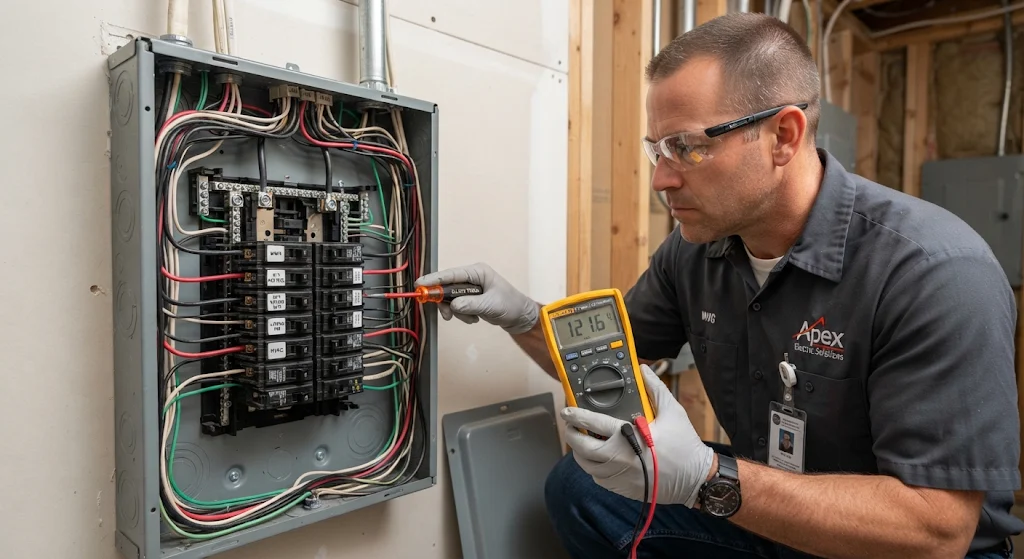
Whole-House Rewiring in Glen Burnie, MD
Safely replace degraded cloth wiring, brittle insulation, and ungrounded two-wire branch circuits in Glen Burnie. Connect with independent licensed electrical contractors specialized in residential rewiring.
Evaluating Residential Wiring Safety in Glen Burnie
Wiring concealed within walls, crawlspaces, and attics delivers electricity silently for decades. However, in Glen Burnie, where properties feature mid-20th century suburban ramblers, coastal cottages, and established subdivisions near the Patapsco watershed, thousands of older structures continue to rely on aging wiring systems engineered before the advent of modern electronics, microprocessors, and high-draw electric appliances.
Located along tidal inlets of the Patapsco and Marley Creek, Glen Burnie contains extensive post-war cottages and 1960s ramblers in Harundale and Ferndale. High water tables mandate robust sump pump circuits, while salt-air humidity causes severe corrosion on outdoor meter bases and service masts.
Over decades of continuous electrical flow, insulation materials deteriorate. Early 20th-century cloth-covered rubber insulation becomes brittle and flakes away from copper conductors when disturbed, while 1960s and 1970s solid-strand aluminum branch wiring suffers from thermal expansion and oxidation at terminal screw connections. Rewiring your property replaces these outdated conductors with modern copper non-metallic sheathed cable (NM-B), establishing robust grounding pathways and code-mandated arc-fault protection.
Residential rewiring process in Glen Burnie
Systematic circuit replacement designed to preserve structural integrity and plaster finishes.
Common Historic Wiring Types Found in Glen Burnie Dwellings
An independent electrician inspecting properties in Glen Burnie often encounters several distinct generations of electrical wiring:
- Knob-and-Tube (K&T) Wiring: Common in homes constructed prior to 1945. It utilizes individual single conductors suspended on ceramic porcelain knobs and routed through protective porcelain tubes. K&T wiring lacks an equipment grounding conductor, cannot be safely surrounded by thermal attic insulation (which traps heat), and is frequently spliced illegally into modern branch boxes.
- Ungrounded Cloth-Covered Two-Wire Romex: Installed extensively from the late 1940s through the mid-1960s. These cables provide hot and neutral wires but omit a dedicated safety ground wire. Outlets with three prongs installed on these circuits create a false impression of grounding unless protected by GFCI circuit interrupters.
- Solid Aluminum Branch Circuit Wiring: Used between 1965 and 1973 during high copper prices. Aluminum expands significantly more than copper under thermal electrical load, causing terminal connections at switches and receptacles to loosen over time, leading to oxidation, high electrical resistance, and fire danger.
- Early Armored Cable (BX Cable): Features a flexible spiral steel sheath. Over decades, the internal paper insulation degrades, and if the outer armor experiences corrosion, the ground fault return path fails.
Considering a House Rewiring Project in
Speak with our Maryland intake coordinators at (888) 605-9975 to connect with independent licensed electricians in Anne Arundel County.
Free referral service. Comprehensive quotes and scopes provided directly by independent contractors.
Partial Versus Whole-House Rewiring
Not every property requires gutting every wall down to the studs. Independent electrical contractors tailor rewiring scopes based on architectural feasibility and structural layout:
- Whole-House Rewiring: Recommended when existing insulation is brittle throughout the entire structure, or when undergoing comprehensive whole-home renovations. Electricians fish new cables through wall cavities, install modern nail-on or cut-in electrical boxes, and wire dedicated 20-amp kitchen small-appliance circuits and bathroom receptacle feeds.
- Partial or Targeted Rewiring: Focuses on high-risk zones—such as replacing ungrounded circuits in kitchens, bathrooms, laundry rooms, and basement crawlspaces—while remediating aluminum wiring through specialized COPALUM or AlumiConn terminal connectors in lower-draw areas.
Methodology for Non-Destructive Wire Fishing
Preserving original architectural finishes is a paramount priority when rewiring in Glen Burnie. Experienced independent electricians employ specialized techniques:
- Attic and Crawlspace Access: Cables are routed vertically down through top plates or upward through sill plates, avoiding cross-stud drywall cutting.
- Long Flex-Drill Bits: Three-to-six foot flexible drill bits with directional wire-guide eyes enable boring through internal horizontal fire-blocks from single outlet cutouts.
- Low-Impact Cut-In Boxes: Modern old-work plastic or fiberglass electrical boxes clamp securely to plaster lath or drywall without requiring structural framing changes.
Permit & Inspection Protocols in Anne Arundel County
Residential rewiring projects in Glen Burnie require electrical permits from Anne Arundel County Department of Inspections and Permits. Licensed master electricians must schedule both a rough-in inspection (inspecting box placement, staple spacing, and wire protection plates before drywall is closed) and a final trim inspection where every receptacle, switch, and breaker is mechanically and electronically tested.
Explore Associated Electrical Solutions in Glen Burnie:
- Does your service panel have capacity for new circuits? Review Electrical Panel Upgrades in Glen Burnie.
- Troubleshooting specific dead circuits? Check Electrical Repair in Glen Burnie.
- Protecting sensitive new electronics? Consider a Standby Generator in Glen Burnie.
Frequently Asked Questions About House Rewiring in Glen Burnie, MD
In most instances, yes. Experienced independent electrical contractors work in designated zones or room-by-room stages, ensuring that temporary power is maintained to critical appliances like refrigerators and HVAC systems overnight.
Skilled residential electricians utilize specialized flex bits, snake rods, and access from unfinished attics, crawlspaces, or basements to minimize drywall cuts. Small exploratory access holes are cut cleanly so drywall repair crews can patch them neatly.
Actuarial fire loss data demonstrates that aging ungrounded knob-and-tube and unmitigated aluminum branch wiring have significantly higher failure rates. Many Maryland property underwriters require certification of removal or COPALUM remediation prior to binding policy coverage.
A true grounded outlet features a physical copper ground conductor running back to the main service panel to safely dissipate fault current. A GFCI installed on an ungrounded 2-wire system provides crucial shock protection by sensing current imbalances, but it does not provide an equipment ground for surge protectors.
Call WATT911 at (888) 605-9975. Our intake team will log your property details and connect you with independent electrical contractors servicing Anne Arundel County experienced in historic and residential rewiring.
A certified, permitted whole-house rewiring eliminates buyer inspection contingencies, satisfies strict Maryland underwriting requirements, and allows buyers to obtain standard homeowners insurance without surcharge premiums.